

Oil Mold Temperature Controllers are widely used in industries such as plastic injection molding, die casting, rubber processing, and composite material production. Compared with water-based systems, Oil Type Mold Temperature Controllers can achieve higher operating temperatures and provide stable heat transfer for demanding manufacturing processes.
However, many users focus only on daily operation and overlook proper maintenance. Small maintenance mistakes can gradually reduce heating efficiency, increase energy consumption, and shorten the service life of Mold Temperature Controllers.
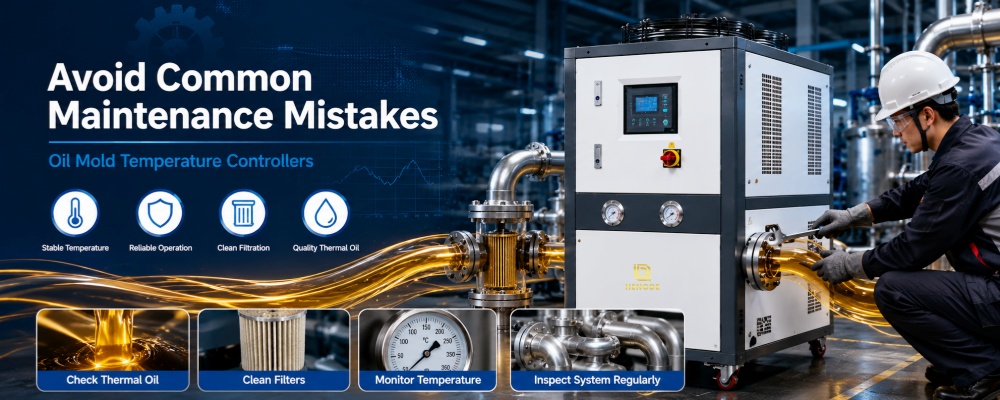
Mistake 1: Waiting Until the Thermal Oil Becomes Completely Dark Before Replacement
Many factories continue using thermal oil until it becomes very dark or develops a strong odor. This is one of the most common mistakes with Oil Mold Temperature Controllers.Thermal oil naturally degrades over time due to continuous high-temperature operation. As the oil ages, its viscosity changes, carbon deposits increase, and heat transfer performance decreases.
Hengde Unique Insight:A significant decline in thermal oil performance often happens before the oil shows obvious color changes. Waiting for the oil to become black may already mean the internal heating system has been affected.
Mistake 2: Ignoring Small Temperature Fluctuations
Some operators believe that a temperature difference of several degrees is normal. However, in precision manufacturing processes, even small fluctuations can affect product consistency. For example, in plastic injection molding, unstable mold temperature may cause dimensional variations, surface defects, and longer cycle times.
Hengde Unique Insight:Many users suspect the heater or controller when temperature stability decreases, but the actual reason may be reduced oil circulation caused by aging thermal oil or partially blocked pipelines.
Mistake 3: Cleaning the Filter Only After an Alarm Appears
The filter inside Oil Type Mold Temperature Controllers plays an important role in protecting the pump and maintaining stable oil circulation.When carbon particles and impurities accumulate, the oil flow decreases and the system has to work harder to maintain the required temperature.
Regular inspection and cleaning of filters should be part of preventive maintenance rather than emergency repair.
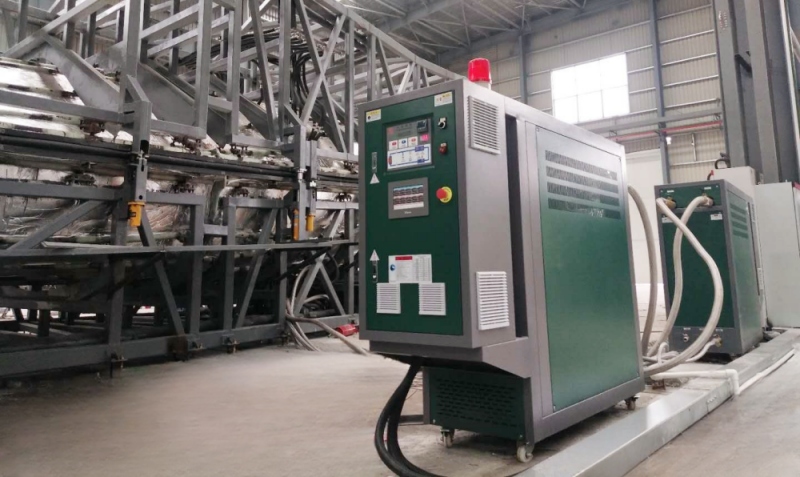
Mistake 4: Using Any Thermal Oil Without Checking Compatibility
Some users believe that all thermal oils are the same. In reality, different thermal oils have different temperature ranges, oxidation resistance, thermal stability, and service life. Choosing unsuitable thermal oil may accelerate oil degradation, increase carbon deposits, reduce heat transfer efficiency, and eventually increase maintenance costs of Oil Mold Temperature Controllers.
Based on Hengde’s practical experience, we recommend selecting high-quality thermal oils from reliable brands such as Mobil, Esso, and TotalEnergies. These well-known industrial thermal oil brands generally provide better thermal stability, oxidation resistance, and longer service life, helping Oil Type Mold Temperature Controllers maintain stable performance under long-term high-temperature operation.
Hengde Unique Insight:A high-temperature Mold Temperature Controller does not always require the most expensive thermal oil. The best choice is the oil whose performance matches the actual operating temperature and production conditions.
Mistake 5: Paying Attention Only to the Machine and Forgetting the Entire System
Many maintenance plans focus on the Oil Mold Temperature Controllers themselves, including heaters, pumps, and electrical components.However, hoses, mold channels, valves, and external pipelines are also part of the temperature control loop.
Hengde Unique Insight:In practical applications, the performance of Mold Temperature Controllers is often limited by the condition of the external circulation system rather than the machine itself.
How Proper Maintenance Extends the Life of Oil Mold Temperature Controllers
Proper maintenance is not only about avoiding breakdowns. It helps maintain accurate temperature control, reduce energy consumption, and keep production quality consistent. A preventive maintenance schedule including oil inspection, filter cleaning, circulation checking, and component inspection can greatly improve the long-term reliability of Oil Type Mold Temperature Controllers.
How Hengde Can Help
With more than 20 years of experience in temperature control equipment manufacturing, Hengde specializes in producing high-quality Mold Temperature Controllers for various industrial applications.Our Oil Mold Temperature Controllers are designed with reliable heating systems, stable oil circulation, high-quality components, and intelligent control systems. We also provide customized solutions according to customers’ temperature requirements, production processes, and installation environments.Choosing the right Mold Temperature Controller is only the first step. Proper maintenance and professional technical support are the key to ensuring long-term stable operation.
Choose Hengde,Choose Perfect Oil Mold Temperature Controller!
WhatsApp : +8618351969707
Email : sales@sinohengde.com
Address : No.1 Jiangyang Line, Hongqi community, Hengxi Street,Jiangning, Jiangsu, China