
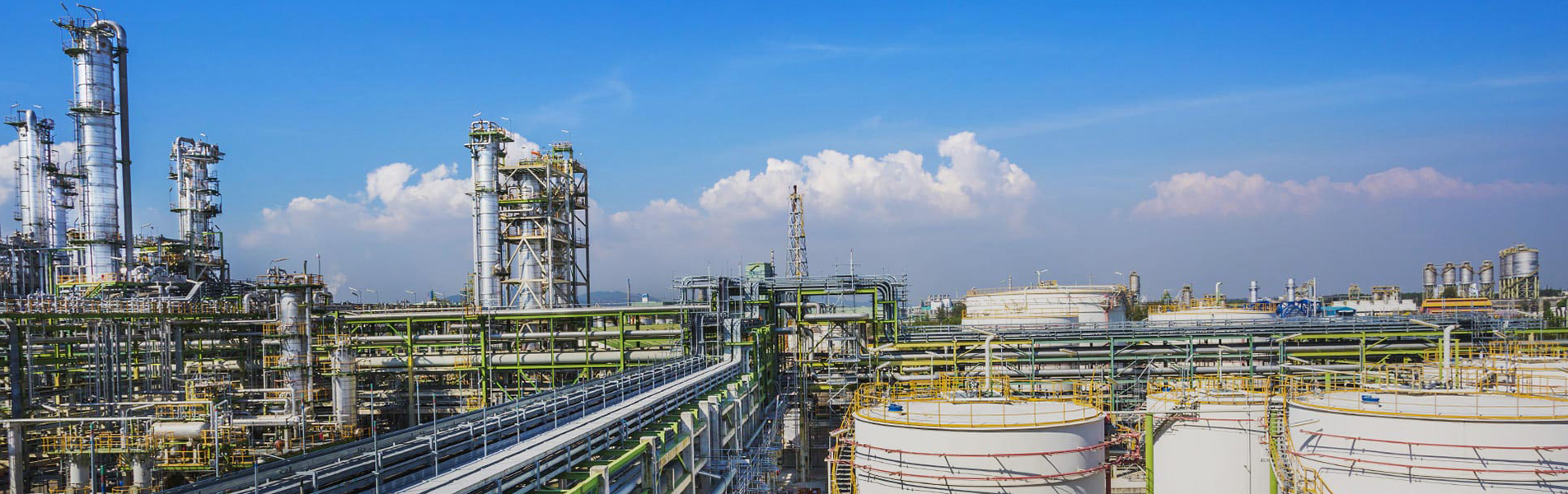
As lithium battery manufacturing continues to expand, temperature control has become one of the key factors affecting product quality and production efficiency. While many people associate Mold Temperature Controllers with injection molding, these systems are also widely used throughout lithium battery production, where maintaining a stable process temperature is critical.
One question we hear frequently from customers is: "Should we use a water mold temperature controller or an oil mold temperature controller for our battery production line?" The answer depends less on the battery itself and more on the temperature requirements of each manufacturing process.
Different Processes Require Different Temperature Ranges
Lithium battery production is made up of several stages, and each has different temperature control requirements.
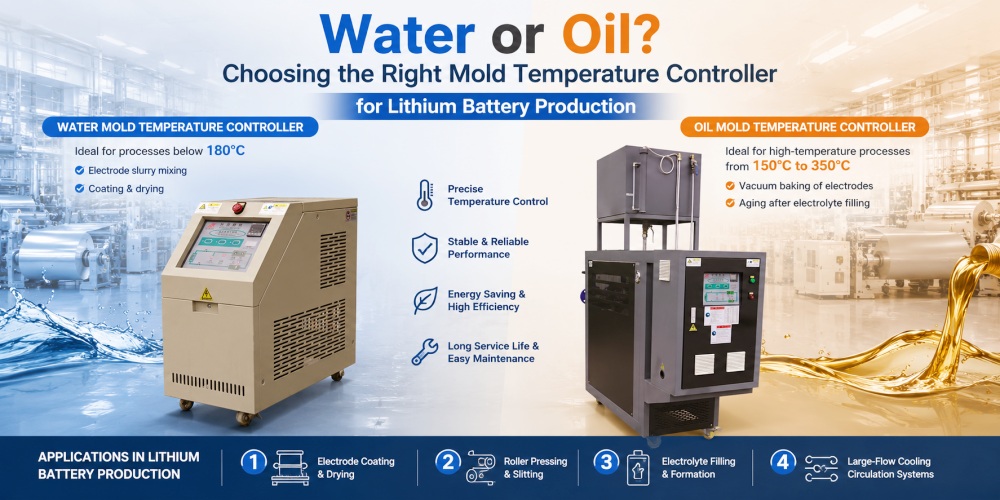
A Water Mold Temperature Controller is generally recommended for processes below 180°C. It offers fast heat transfer, precise temperature control, and excellent energy efficiency. Typical applications include:
For these processes, temperature stability is often more important than extremely high temperatures. Water provides quick heat exchange, helping maintain consistent product quality while reducing energy consumption.
An Oil Mold Temperature Controller, on the other hand, is designed for high-temperature applications between 200°C and 350°C. Thermal oil remains stable where water is no longer suitable, making it the preferred choice for demanding thermal processes. Typical applications include:
Rather than competing with each other, water and oil systems serve different purposes within the same production line.
Where Mold Temperature Controllers Are Used in Battery Production
Modern lithium battery plants use temperature control equipment in more areas than many people expect. Some of the most common applications include:
1. Electrode Coating and Drying
Temperature stability directly affects coating consistency and solvent evaporation. Even small fluctuations may influence coating quality.
2. Roller Pressing and Slitting
Maintaining stable roller temperature helps improve dimensional consistency while reducing thermal deformation during continuous production.
3. Electrolyte Filling and Formation
Certain production steps require carefully controlled temperatures to improve process stability and product consistency.
4. Large-Flow Cooling Circulation Systems
Many battery factories also require large-capacity cooling circuits to remove heat from production equipment and maintain stable operating conditions.
As production capacity increases, these systems become increasingly important for maintaining continuous operation.
Water Isn't Always Better, and Oil Isn't Always Hotter
A common misconception is that choosing the higher-temperature machine automatically provides greater flexibility.
In reality, selecting a temperature controller that significantly exceeds the process requirement may increase operating costs without improving production quality. If your production temperature never exceeds 120°C, installing a 300°C oil temperature controller usually offers little practical benefit. Likewise, attempting to perform a 250°C process with a water temperature controller is simply unrealistic.
Selecting equipment that matches the actual process is often the most economical solution.
Think About the Entire Production Line, Not Just One Machine
Many factories purchase temperature controllers one production step at a time. This approach works initially but often creates management challenges later. For example, different temperature controllers may use different communication protocols, control interfaces, or maintenance schedules.
Hengde Unique Insight:Instead of selecting individual machines separately, many experienced battery manufacturers now evaluate the entire temperature control system before purchasing equipment. This makes future expansion, maintenance, and automation integration much easier.
Stable Temperature Means Stable Battery Quality
Temperature affects far more than heating efficiency.Consistent temperature helps improve coating uniformity, reduce process variation, and maintain repeatable production conditions.
While battery performance depends on many factors, stable thermal control helps reduce unnecessary process fluctuations throughout manufacturing.
Hengde Unique Insight:Many engineers focus on achieving the target temperature, but experienced production managers pay closer attention to how consistently that temperature is maintained throughout an entire production shift.
Maintaining ±1°C for twelve continuous hours is often more valuable than reaching the target temperature quickly but allowing frequent fluctuations.
Choosing the Right Partner Matters
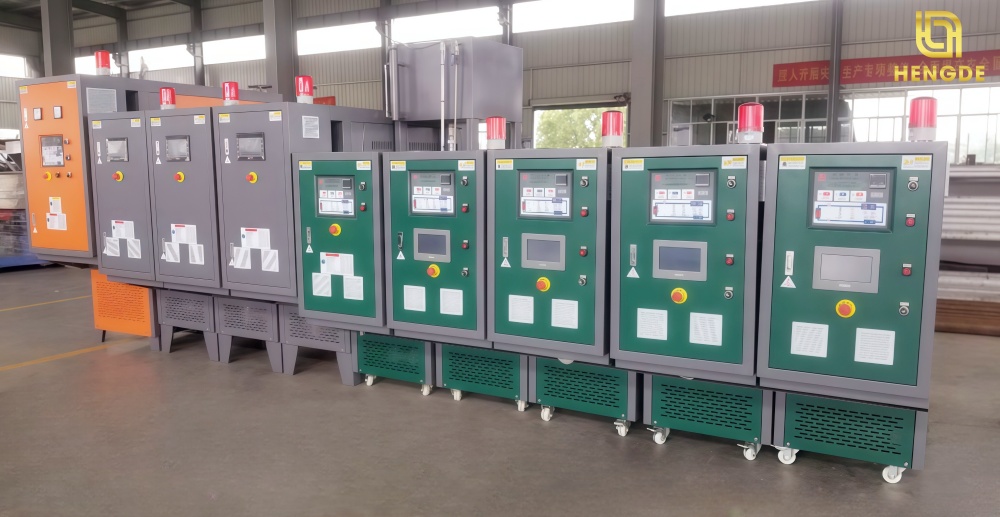
Industrial temperature control equipment for lithium battery production is rarely a standard off-the-shelf product. Different production lines require different heating capacities, flow rates, piping layouts, communication interfaces, and safety configurations. Working with a manufacturer that understands lithium battery processes can simplify equipment selection and reduce commissioning time.
How Hengde Supports Lithium Battery Manufacturers
For more than 20 years, Hengde has specialized in designing and manufacturing Mold Temperature Controllers for demanding industrial applications. Our temperature control solutions are widely used in the lithium battery industry, supporting customers throughout key production stages including electrode coating and drying, roller pressing and slitting, electrolyte filling and formation, and large-flow cooling circulation systems.
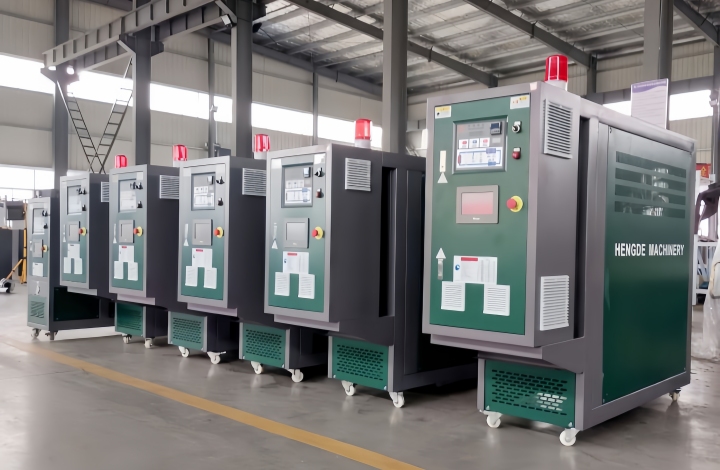
Hengde provides both Water Mold Temperature Controllers (up to 180°C) and Oil Mold Temperature Controllers (up to 350°C), allowing manufacturers to choose the most suitable solution for each production process.
Our engineering team also offers customized systems based on heating capacity, circulation flow, communication requirements, and factory layout, helping battery manufacturers achieve stable temperature control, reliable production, and long-term operational efficiency.
WhatsApp : +8618351969707
Email : sales@sinohengde.com
Address : No.1 Jiangyang Line, Hongqi community, Hengxi Street,Jiangning, Jiangsu, China